The Trauma You Can't Talk Your Way Out Of: The Body Keeps the Score by Bessel van der Kolk
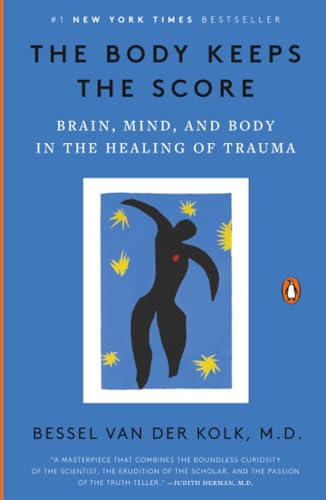
Cover shown for review. As an Amazon Associate, Coach Kev earns from qualifying purchases.
Bessel van der Kolk spent decades sitting with people whose lives had been organized around something terrible that happened to them, and The Body Keeps the Score is his attempt to explain what he learned, which begins with a claim that reorders everything. Trauma, he argues, is not the event itself, not the war or the crash or the childhood you did not choose, it is the imprint that event left behind in your body, your brain, and your nervous system, an imprint that keeps running long after the danger is gone. The story of what happened is real, and the story is not where the trauma lives, the body is.
The part of the book that changed how I think came from the brain scans. When van der Kolk and his colleagues watched what happened inside the brain during a flashback, they found that Broca's area, the region responsible for putting experience into speech, went quiet, measurably less active, while the fear centers lit up. He calls this speechless terror, and it explains something that talk therapy alone kept running into, that you cannot always narrate your way out of a wound that was encoded in a state where the language part of your brain was offline. The words are not missing because you are avoiding them, they are missing because they were never filed there in the first place.
What the body files instead is readiness. A nervous system that learned the world was dangerous does not forget the lesson politely, it stays braced, scanning, quick to fire, and it treats a raised voice or a certain smell or a particular silence as evidence that the old threat has returned. Van der Kolk describes trauma as a kind of timelessness, where the past does not feel like the past, it feels like right now, because the body cannot tell the difference between a memory and a present emergency when the alarm is loud enough. The person is not being dramatic, their system is doing exactly what it was trained to do.
For the audience I write for, the reframe in that is enormous, and it lands the same way the rest of Data-Driven Zen does. The startle, the shutdown, the disproportionate reaction you have been ashamed of for years, none of that is a character flaw or a failure of willpower, it is a physiological event, a smoke alarm that never got reset after the fire. You cannot think your way out of a smoke alarm, and every time you have tried and failed you have taken it as more proof that something is wrong with you, when the real problem was that you were using the wrong tool on the wrong layer of the system.
The right tool, in van der Kolk's work, tends to run from the bottom up rather than the top down. Rather than starting with insight and hoping the body follows, he points toward approaches that speak to the body directly, breath, movement, rhythm, yoga, safe human connection, the slow retraining of a nervous system that needs to learn, through experience and not through argument, that it is safe now. You regulate the body first, and only then does the thinking brain come back online well enough to do the reflecting, which is the exact reverse of how most of us were taught to fix ourselves.
I want to be honest about the limits, because van der Kolk is. This is not a book that promises a clean cure, and it does not claim that any single technique works for everyone, and it does not pretend that you can white-knuckle severe trauma alone with a paperback. If what you are carrying is heavy, professional help is not a weakness, it is the appropriate tool for the load. What the book offers is not a shortcut, it is a map, an honest account of what trauma actually is so that you can stop fighting the wrong war with the wrong weapons.
So the rep here is one of attention. For a single day, treat the signals your body sends as information rather than as embarrassment, notice where the tension sits, notice what your breath does when a certain name comes up, notice the moments your system braces for no reason your thinking mind can name. You are not trying to fix any of it today, you are just learning to read the instrument panel, because the body has been keeping the score all along and most of us were never taught to look at it.
The Body Keeps the Score is a dense and deeply humane book, part science and part case history and part quiet argument for treating people as whole systems rather than broken minds, and if you have ever wondered why the insight never seemed to reach the part of you that actually hurts, it will answer that. You can find it here: https://www.amazon.com/dp/0143127748?tag=cklu-ionos-20. Read it and you stop asking why you cannot get over it by thinking harder, and you start asking a better question, which is how you help a body finally believe the danger has passed.