Counting What Went Right: Thanks!, by Robert A. Emmons
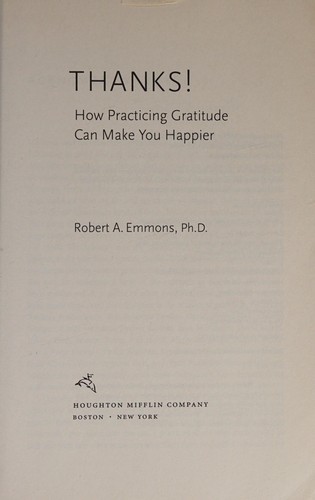
Cover shown for review. As an Amazon Associate, Coach Kev earns from qualifying purchases.
The day after Thanksgiving is a strange moment to talk about gratitude. For some of us the table was full and easy, and for others it held an empty chair, a tense conversation or a long drive home with nothing left in the tank. This week's Friday Book Review is Thanks!: How the New Science of Gratitude Can Make You Happier by Robert A. Emmons, first published in 2007. It takes a feeling we usually treat as a holiday mood and treats it instead as something we can practice and measure.
The premise: gratitude as a practice
Emmons is a psychologist at the University of California, Davis, and much of the early experimental research on gratitude carries his name. The book argues that gratitude has two parts. The first is noticing that something good has happened to us. The second is recognizing that at least part of its source sits outside ourselves, in other people, in luck or in whatever larger order a reader believes in. In his account, that second step is what separates gratitude from simple satisfaction, because it points our attention outward.
From there the book moves into practice. Emmons describes gratitude journals, letters of thanks and the habit of noticing what other people did to make a good day possible. He also spends time on what gets in the way, including entitlement, comparison and the sense that we earned everything we have. Those chapters read less like a pep talk and more like a field guide to the attitudes that crowd gratitude out.
What the research says
The study behind the book that gets cited again and again is one Emmons ran with Michael McCullough, published in 2003 in the Journal of Personality and Social Psychology. Across three experiments, participants were randomly assigned to list things they were grateful for, list hassles, or record neutral events or comparisons. One of the studies included people living with neuromuscular disease. The gratitude groups showed higher well-being on several of the outcome measures, though not on all of them, and the effect on positive mood was the steadiest result.
Later research tested the idea more strictly. In 2016 Don Davis and colleagues published a meta-analysis of gratitude interventions in the Journal of Counseling Psychology. Gratitude exercises beat doing nothing on psychological well-being, with a modest effect. Against an activity-matched comparison the effect on well-being was small. Against a psychologically active comparison, such as another structured exercise designed to help, gratitude performed about as well and no better. The same analysis found no reliable effect on anxiety.
Where the book is weaker
That later evidence is the context a reader needs. Thanks! was written early in this research, and its tone runs ahead of what the studies now support. Gratitude practice appears to help a little, about as much as other good habits do, which is worth something without being a cure. Some of the claims in the book's lighter chapters about health rest on correlations, and a correlation between grateful people and healthy people does not show that one causes the other.
The bigger risk is how gratitude gets used. Telling someone in pain to count their blessings can turn a practice into a way of dismissing them. If you are grieving this season, gratitude does not have to compete with the loss, and nobody owes the holiday a cheerful face. If low mood, anxiety or numbness shows up most days, a gratitude journal is not the treatment, and a doctor or licensed counselor is the right next step.
For Leaders
Emmons's second step, seeing where the good came from, is something a team can practice together. In many workplaces thanks goes to the person who presented the result while the people who did the quiet work stay invisible. At your next team meeting, name one specific contribution that made a recent success possible and the person behind it. Keep it concrete, because a vague thank-you to everyone teaches your team that nobody's work was really seen.
For Individual Contributors
Gratitude at work is easy to fake and hard to practice honestly. For one week, end each workday by writing down one thing that went right and who or what helped it happen. If a colleague shows up on that list twice, tell them in a sentence what they did and why it mattered. You are not trying to feel thankful on command, you are training your attention to notice what was already there.
The rep
Tonight, write down three things that went right this week and, beside each one, the person or circumstance that made it possible. Keep the list short and specific rather than grand. Try it three times over the next week, then compare how you feel against a week without it, and stop if it starts to feel like a chore you are performing for someone else.
Now the real work begins.
The book: Thanks!: How the New Science of Gratitude Can Make You Happier by Robert A. Emmons (Houghton Mifflin, 2007; paperback as Thanks!: How Practicing Gratitude Can Make You Happier, Houghton Mifflin Harcourt, 2008).
References
Emmons, R. A., & McCullough, M. E. (2003). Counting blessings versus burdens: An experimental investigation of gratitude and subjective well-being in daily life. Journal of Personality and Social Psychology, 84(2), 377-389. https://doi.org/10.1037/0022-3514.84.2.377
Davis, D. E., Choe, E., Meyers, J., Wade, N., Varjas, K., Gifford, A., Quinn, A., Hook, J. N., Van Tongeren, D. R., Griffin, B. J., & Worthington, E. L., Jr. (2016). Thankful for the little things: A meta-analysis of gratitude interventions. Journal of Counseling Psychology, 63(1), 20-31. https://doi.org/10.1037/cou0000107
Stay in the loop
Get new posts by email
Pick what you want and I will send it to you.
I will email you the posts you tick, about once a week. You can change what you get or leave from the bottom of any email. Your address stays with me and my email service, Kit.