The Story You're Making Up: Rising Strong by Brené Brown
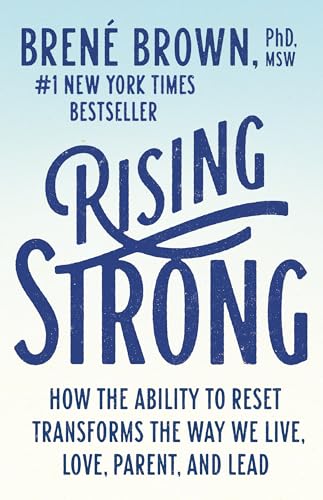
Cover shown for review. As an Amazon Associate, Coach Kev earns from qualifying purchases.
Brené Brown built her career at the University of Houston studying the things most of us spend our lives avoiding, shame, vulnerability, and the courage it takes to be seen, and Rising Strong is the book she wrote about the part of the story nobody frames on the wall. Everyone loves the fall and the comeback, the before and the triumphant after, and Brown parks herself in the middle, in the wreckage right after you go down, and asks the more useful question, which is what a person actually does in the space between hitting the ground and getting back up. She calls the getting-up a skill, not a personality trait, which means it can be learned.
She breaks the process into three movements, the reckoning, the rumble, and the revolution, and the language matters less than the shape. The reckoning is simply noticing that you have been emotionally hooked, that something landed and you are now in a feeling whether you wanted to be or not. The rumble is where the real work sits, the willingness to get honest about the story you are telling yourself about what happened. The revolution is what happens when doing that enough times slowly changes how you live, which is the quiet, unglamorous way most people actually transform.
The tool I reach for constantly, and the one I hand to clients again and again, is a sentence she teaches you to say out loud, the story I am making up is. Brown draws on research into how the brain handles uncertainty, including Robert Burton's work on the feeling of certainty, and the finding underneath it is uncomfortable and freeing at once, that your brain rewards you chemically for completing a story, even a false one, because a finished story feels safer than an open question. So in the absence of real information your mind writes a draft, usually an unflattering one, and then hands it to you stamped as fact.
Naming that draft as a draft is the entire move. When you say the story I am making up is that they are disappointed in me, or that I failed, or that I am about to be left, you do two things at once, you take the story seriously enough to look at it, and you strip it of its disguise as objective truth. It stops being reality and becomes what it always was, a first attempt at meaning written by a nervous system under stress, and a first attempt is something you are allowed to revise once the actual facts come in. That small linguistic shift opens a gap where certainty used to be.
Brown also draws a strikingly clear line between guilt and shame, and it matters here because most people rumble with the wrong one. Guilt says I did something bad, it points at a behavior, and it can move you toward repair. Shame says I am bad, it points at your whole self, and it moves you toward hiding, which is the opposite of the honesty the rumble requires. A great deal of what feels like accountability is actually shame in a work shirt, and it does not make you better, it just makes you smaller and quieter and less able to face the thing at all.
I appreciate that Brown refuses to make any of this look clean, because the temptation in this genre is to sell rising strong as a tidy arc with a bow on it. The rumble is uncomfortable by design, it asks you to sit in not-knowing and to question a story your body desperately wants to believe, and vulnerability, in her framing, is not weakness or oversharing, it is the willingness to show up when you cannot control the outcome. That is a demanding definition, and it is a far more honest one than the version that treats vulnerability as a performance you do for applause.
The rep is one sentence and a pause. The next time something knocks you sideways and a fast, certain, painful conclusion snaps into place, reach for her words before you act on it, write or say the story I am making up is, finish the sentence honestly, and then ask yourself the follow-up, what do I actually know here versus what am I filling in. You are not forcing a nicer story, you are just refusing to act on the first draft as though it were the final one.
Rising Strong is a warm, rigorous, unusually practical book about the unglamorous middle of any comeback, the messy part where the work is actually done, and it pairs the research with enough of Brown's own falls that it never floats off into theory. You can find it here: https://www.amazon.com/dp/081298580X?tag=cklu-ionos-20. Read it and you come away with one sentence that will save you more grief than most of what passes for wisdom, because so much of what we suffer is not what happened, it is the story we made up about what happened and then believed without checking.