The Belief Needs a Room That Agrees: Mindset, by Carol S. Dweck
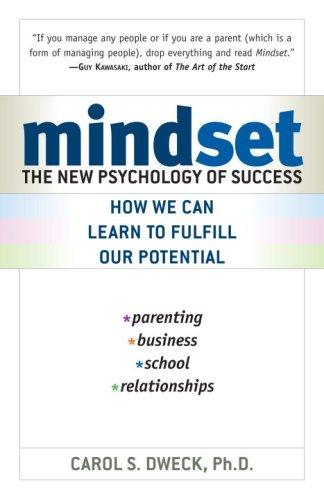
Cover shown for review. As an Amazon Associate, Coach Kev earns from qualifying purchases.
If you have ever stopped trying something the moment it got hard and told yourself you were simply not a numbers person, you already know the belief this book is about. That quiet verdict, the one that says ability is a fixed amount you were handed at birth, can close a door long before any real test of what you could learn. This week's Friday Book Review is Mindset: The New Psychology of Success by Carol S. Dweck, first published in 2006. It argues that the verdict is a belief rather than a fact and that the belief can change.
The premise: two ways of reading a setback
Dweck, a psychologist at Stanford, describes two broad beliefs about ability. In what she calls a fixed mindset, intelligence and talent are set quantities. Every challenge becomes a test of how much you have, and every failure becomes evidence that you do not have enough. In a growth mindset, ability develops through effort, good strategies and help from others. A setback then becomes information about what to try next.
Her case is that the two beliefs lead people to make very different choices. Someone who holds the fixed view tends to avoid hard problems that might expose a limit. They hear criticism as a judgment of their worth and feel threatened by other people's success. Someone who holds the growth view tends to seek out the challenge, to use the criticism and to treat a colleague's success as a lesson. The book walks those patterns through school, sport, business and relationships. It puts strong emphasis on how parents, teachers and managers pass one belief or the other to the people they lead.
What the research says
The research on this idea is more mixed than the book's tone suggests, and that is worth knowing before you build a program around it. In 2018 Victoria Sisk, Alexander Burgoyne and colleagues published two meta-analyses in Psychological Science. The first looked at how strongly mindset is linked to academic achievement across 273 studies and more than 365,000 students. The second tested whether mindset interventions raise achievement across 43 studies and more than 57,000 students. Both found weak overall effects, although the authors noted that students from low-income backgrounds or who were academically at risk might benefit.
A year later, David Yeager and a large team published a national experiment in Nature. A short online growth mindset program of under an hour improved grades among lower-achieving students in a nationally representative sample of United States secondary schools. It also raised enrollment in advanced math. The part that matters for adults is the condition attached to it, because the program changed grades in schools where peer norms supported its message. The belief helped where the room agreed with it.
Where the book is weaker
Mindset is written for a general audience, and it leans on stories of athletes, executives and students far more than on the effect sizes behind them. The two-camp framing is also neater than real life, since one person can hold the growth view about leadership and the fixed view about math at the same time. A reader can finish the book with a new label for a coworker or a child, and a label can do harm if it turns into one more verdict.
There is also a quiet risk in the message. Believing that effort matters is useful. Believing that every limit is a failure of effort can turn into self-blame, especially for someone dealing with illness, disability or an unfair system. If setbacks leave you stuck in harsh self-criticism or low mood most days, raise it with a doctor or a licensed counselor. That is a health matter and not a mindset problem.
For Leaders
The Yeager finding puts the weight on the environment, which in a workplace means you. Your team learns what you really believe about ability from how you react to a mistake, from who gets the stretch assignment and from whether you praise the outcome or the approach that produced it. Before you run a workshop on growth mindset, look at whether your own review process punishes the person who tried something hard and missed. A team will follow the norm you reward over the poster on the wall.
For Individual Contributors
Notice the moment you hear yourself say "I am just not good at this," and treat it as a hypothesis to test rather than a finding. Pick one skill you have written off, break it into a small piece you can practice, and ask one person who is good at it what they would try first. Effort alone is not the lever, because more of the same approach usually produces more of the same result, so change the strategy as well as the hours.
The rep
This week, write down one sentence you tell yourself about something you cannot do. Rewrite it with the word "yet" at the end, then add one concrete next step and one person who could help. Try the step once before Friday and be honest about the result, because the point is to test the belief rather than perform a new one.
Now the real work begins.
The book: Mindset: The New Psychology of Success by Carol S. Dweck (Random House, 2006; Ballantine paperback, 2007).
References
Sisk, V. F., Burgoyne, A. P., Sun, J., Butler, J. L., & Macnamara, B. N. (2018). To what extent and under which circumstances are growth mind-sets important to academic achievement? Two meta-analyses. Psychological Science, 29(4), 549-571. https://doi.org/10.1177/0956797617739704
Yeager, D. S., Hanselman, P., Walton, G. M., et al. (2019). A national experiment reveals where a growth mindset improves achievement. Nature, 573(7774), 364-369. https://doi.org/10.1038/s41586-019-1466-y
Stay in the loop
Get new posts by email
Pick what you want and I will send it to you.
I will email you the posts you tick, about once a week. You can change what you get or leave from the bottom of any email. Your address stays with me and my email service, Kit.