The Smartest Person in the Room Still Lost the Room: Why Emotional Intelligence Is Really About Self-Regulation
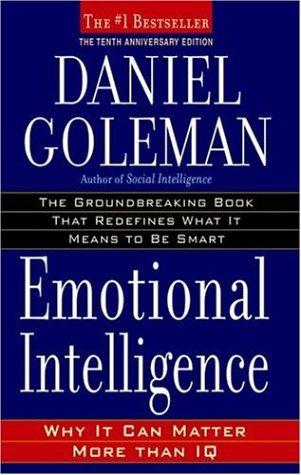
Cover shown for review. As an Amazon Associate, Coach Kev earns from qualifying purchases.
Daniel Goleman was a science journalist covering behavioral research for the New York Times when he pulled together a body of neuroscience and psychology most people had never connected into a single popular argument, and Emotional Intelligence: Why It Can Matter More Than IQ (Intelligence Quotient) is still the book that put the term in front of the general public. It belongs in the Life Uncensored library because it dismantles a belief that quietly runs most workplaces and most households, that raw cognitive horsepower is the main thing determining who succeeds. Goleman's case, built on decades of prior research he is synthesizing rather than inventing from scratch, is that the ceiling on how far intelligence takes you is set by something else entirely, how well you notice and manage your own emotional state before it manages your behavior for you.
The claim worth being precise about, because the popular version of this book has gotten fuzzy over thirty years of repetition, is not that emotional intelligence (EQ) replaces IQ or that intelligence does not matter. Goleman is drawing directly on the academic model built by psychologists Peter Salovey and John Mayer, who defined emotional intelligence in their 1990 paper in the journal Imagination, Cognition, and Personality as the ability to monitor your own and others' feelings, discriminate among them, and use that information to guide thinking and action. IQ sets a floor on what kind of problems you can solve. EQ determines whether you can access that intelligence at all in the moment it is actually needed, which is usually the moment you are angry, afraid, or humiliated, which is to say the moment your reasoning is most likely to be hijacked before it ever gets used.
The mechanism Goleman leans on hardest comes from neuroscientist Joseph LeDoux's research on the amygdala, the almond-shaped structure deep in the brain that processes threat and emotion. LeDoux mapped what he called the low road, a shortcut of neural signal that reaches the amygdala directly from the thalamus, bypassing the neocortex, the part of the brain responsible for reasoned analysis, entirely. That shortcut exists for a real evolutionary reason, so you can flinch from a snake before you have consciously identified it as a snake, and it evolved for physical danger, not for a curt email or a public correction in a meeting. Goleman calls the emotional version of this an amygdala hijack: your reasoning brain gets the story seconds after your emotional brain has already started running the response, which is why smart people say things in an argument that no amount of intelligence would have predicted or endorsed five minutes earlier.
The part of the book I use constantly in coaching is Goleman's insistence that this is a skill and not a fixed trait, distinct from IQ in exactly the way that matters most. You cannot meaningfully train your way to a higher intelligence quotient in adulthood, but the four capacities he organizes emotional intelligence around, self-awareness, self-management, social awareness, and relationship management, are trainable at any age, because they are built on noticing patterns you can practice noticing more often. The gifted, high-achieving person who keeps sabotaging their own relationships or their own team is rarely missing intelligence. They are missing the half-second of awareness between the trigger and the response, and that half-second is exactly the thing practice lengthens.
The rep, and it is a genuinely small one: the next time you feel a spike today, the tightening jaw, the heat in your face, the urge to fire back immediately, name the emotion out loud or in writing before you do anything else with it. Not the story about why you are right. Just the word: angry, embarrassed, afraid, dismissed. Naming the state, according to the affect-labeling research this line of work eventually produced, measurably reduces the amygdala's activity and hands some control back to the reasoning brain. You are not suppressing the feeling. You are giving your neocortex enough time to catch up to it.
For Leaders
This matters past your own reactions because your team calibrates what is safe to bring you by watching how you handle being surprised, criticized, or contradicted in real time. A leader with a high IQ and no regulation is not read as brilliant. They are read as unpredictable, and a team spends enormous energy managing around unpredictability instead of doing the work. The fix is not suppressing your reactions in front of people. It is narrowing the gap between the trigger and the response until what they see is closer to your actual judgment than to your amygdala's first draft.
For Individual Contributors
The practice is tracking your own hijacks after the fact rather than judging yourself for having them, because the goal is not to become a person who never gets triggered. It is to shorten the window between the trigger and the moment you notice you are in one, and that window only shortens with repetition, the same way any other trainable skill does.
This is not a book claiming that being smart does not matter. It is a book making the narrower and better-supported case that intelligence without regulation is a car with a powerful engine and no steering, and Emotional Intelligence is worth the read even three decades on: https://www.amazon.com/dp/055338371X?tag=cklu-ionos-20. The room was never lost because you were not smart enough. It was lost in the half-second before you noticed you had already stopped thinking.