The Struggle Is the Trap: The Happiness Trap, by Russ Harris
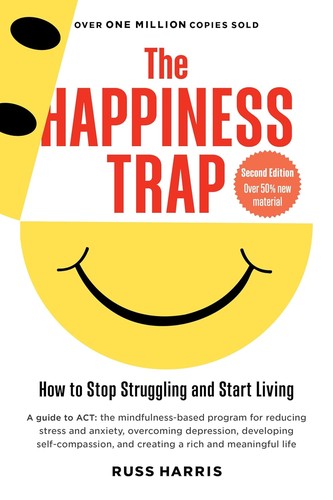
Cover shown for review. As an Amazon Associate, Coach Kev earns from qualifying purchases.
December has a way of suggesting that everyone else is happy on schedule. The lights go up and the music turns cheerful. If you are carrying something heavy through all of it, the gap between how you feel and how you are supposed to feel can become one more thing to fix. This week's Friday Book Review is The Happiness Trap: How to Stop Struggling and Start Living by Russ Harris, first published in 2007 and released in a revised second edition in 2022. Its argument is that the fixing itself is often the problem, and that a fuller life starts when we stop requiring our feelings to cooperate first.
The premise: the fight makes it bigger
Harris is a medical doctor who became a therapist and a trainer in Acceptance and Commitment Therapy (ACT), a form of behavioral therapy developed by the psychologist Steven C. Hayes and his colleagues. The book translates that therapy for a general reader. Its central claim is that the effort we pour into getting rid of anxious thoughts, sadness or self-doubt tends to give those experiences more room in our lives rather than less. We avoid the situations that trigger them and we argue with them or numb them. Slowly, the life we wanted gets organized around not feeling bad.
The alternative Harris offers has two halves, which is where the therapy gets its name. The acceptance half teaches you to hold difficult thoughts and feelings more loosely. One of the book's signature moves is to put a short phrase in front of a painful thought. "I am a failure" becomes "I am having the thought that I am a failure", which turns a verdict back into a sentence your mind produced. The commitment half asks what you actually care about and what small action you could take toward it today, with the feeling still present. The goal is not to feel better first and live second, it is to live by your values while the feelings come along for the ride.
What the research says
The therapy behind the book has a substantial research record. In 2015 Jacqueline A-Tjak and colleagues published a meta-analysis in Psychotherapy and Psychosomatics that pooled 39 randomized controlled trials covering 1,821 patients with mental or physical health problems. ACT outperformed waitlist, placebo and usual-care comparisons, with a moderate overall effect. When ACT was compared with cognitive behavioral therapy, the established standard, the analysis found no significant difference between them.
A 2020 review by Andrew Gloster and colleagues in the Journal of Contextual Behavioral Science stepped back further and examined 20 meta-analyses covering 12,477 participants. It found ACT efficacious for anxiety and depression as well as for substance use, pain and mixed conditions. ACT generally beat inactive controls, usual care and most active comparisons. Cognitive behavioral therapy was the notable exception, and there the two performed comparably.
Where the book is weaker
Those trials tested therapy delivered by trained clinicians, usually to people with diagnosed conditions. They did not test a reader working through a paperback alone, so the book is best understood as a well-grounded introduction to an effective therapy rather than as the therapy itself. Some of the exercises take practice to land, and a reader who tries the phrase about thoughts once and feels nothing may decide the whole approach is a gimmick when it simply needs repetition.
The word acceptance also needs care. Harris means making room for an internal experience, a thought or a feeling, so it stops running the show. He does not mean accepting a situation that is harming you, such as a relationship that frightens you or a job that is wearing your health down. Read carelessly, the book could be used to sit quietly with something that calls for action, and the commitment half exists precisely so that does not happen. If low mood, anxiety or painful memories show up most days, a doctor or licensed counselor is the right next step. If thoughts of harming yourself appear, the 988 Suicide and Crisis Lifeline is available by call or text in the United States.
For Leaders
Many leaders wait to feel confident before they make the hard call, and the waiting can quietly stretch from days into quarters. The book offers a different order of operations. Before your next difficult decision, name the discomfort plainly to yourself. Then name the value the decision serves, whether that is fairness to the team or the health of the business. Take the first concrete step with the nerves still present, because your team needs the decision more than it needs you to feel calm while making it.
For Individual Contributors
Before a presentation or a hard conversation, a familiar sentence often shows up, such as "I am not good enough for this." Instead of arguing with it, try the book's move and say quietly, "I am having the thought that I am not good enough for this." Then do the next small thing on your list, whether that is the next slide or the first sentence of the conversation. You are not trying to make the thought disappear, you are practicing doing your work while it is in the room.
The rep
Once a day for the next week, notice one painful thought or feeling that shows up, and name it with the phrase "I am having the thought that" or "I am noticing a feeling of". Then ask what matters to you in that moment and take one small action toward it, even if the feeling stays. At the end of the week, look back and notice whether the feelings ran your days as much as usual. Be honest if the answer is yes, because that tells you where the practice needs more time.
Now the real work begins.
The book: The Happiness Trap: How to Stop Struggling and Start Living by Russ Harris (first published 2007; Trumpeter, 2008; second edition, Shambhala, 2022).
References
A-Tjak, J. G. L., Davis, M. L., Morina, N., Powers, M. B., Smits, J. A. J., & Emmelkamp, P. M. G. (2015). A meta-analysis of the efficacy of acceptance and commitment therapy for clinically relevant mental and physical health problems. Psychotherapy and Psychosomatics, 84(1), 30-36. https://doi.org/10.1159/000365764
Gloster, A. T., Walder, N., Levin, M. E., Twohig, M. P., & Karekla, M. (2020). The empirical status of acceptance and commitment therapy: A review of meta-analyses. Journal of Contextual Behavioral Science, 18, 181-192. https://doi.org/10.1016/j.jcbs.2020.09.009
Stay in the loop
Get new posts by email
Pick what you want and I will send it to you.
I will email you the posts you tick, about once a week. You can change what you get or leave from the bottom of any email. Your address stays with me and my email service, Kit.