Your Should Statements Are Not Your Conscience: Feeling Good
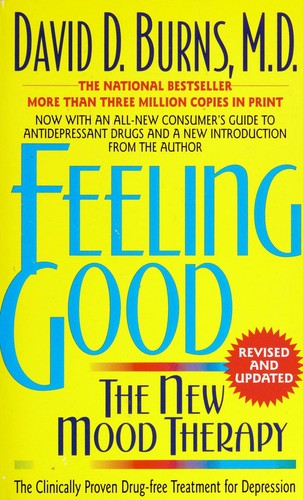
Cover shown for review. As an Amazon Associate, Coach Kev earns from qualifying purchases.
Listen to the sentences you say to yourself on a heavy day and count how many of them contain the word should. I should have caught that. I should be further along by now. I should not feel this way about something so small. Each one sounds like conscience, the voice of a person with standards, and that is exactly why so few of them ever get questioned.
David Burns questioned them in 1980, in a book that has stayed in print for more than four decades. Feeling Good: The New Mood Therapy took the cognitive therapy that Aaron Beck was developing at the University of Pennsylvania, where Burns trained, and translated it for a reader at the kitchen table rather than a patient on a couch. The title oversells a little, and I will come back to that. The engine underneath it is solid, and it is the engine CBT (Cognitive Behavioral Therapy) still runs on.
The premise: feelings follow thoughts
The central claim is simple. Your emotions are not a direct readout of events, they are a response to what you tell yourself about events. When the thought is distorted, the feeling that follows is distorted too, and it feels every bit as true as an accurate one. That last part is the trap. A feeling cannot tell you whether the thought behind it was fair.
Burns names ten distortions that show up again and again. Some are familiar on sight: all-or-nothing thinking, where one flaw makes the whole effort a failure; overgeneralization, where one bad event becomes a pattern; disqualifying the positive, where anything that went well somehow does not count. Two of them deserve more attention than the rest for anyone who carries guilt.
The two distortions that run guilt
Should statements. Burns argues that shoulds aimed at yourself tend to produce guilt and pressure, and shoulds aimed at other people tend to produce resentment. The problem is not that you have standards. The problem is that a should arrives with a verdict already attached, so instead of a goal you get a charge sheet, and the charge sheet never mentions what was realistic at the time.
Emotional reasoning. I feel guilty, therefore I must have done something wrong. This one is quiet and very convincing, because the feeling is real even when the conclusion is not. A capable person can carry a low hum of guilt for years and treat the hum itself as proof of a crime nobody can name.
Here is where the book is more careful than its reputation. Burns does not say all guilt is a distortion. When you have actually harmed someone, remorse is the appropriate response, and it points you toward repair. What he goes after is guilt that is out of proportion, guilt that keeps punishing after the lesson has landed, and guilt attached to things that were never yours to control. The tool is a way of sorting the two, not a way of switching your conscience off.
The tool: three columns
The practical heart of the book is a written exercise. Draw three columns. In the first, write the automatic thought exactly as your head said it. In the second, name the distortion, if there is one. In the third, write a response that is more accurate, not more cheerful, which is the distinction many readers miss on a first pass.
The reason it works is the same reason a bug is easier to fix once it has an error code. A thought that has been written down and labeled is no longer the weather. It is a sentence on a page, and a sentence can be checked.
What the research says
The book has unusual evidence behind it for a self-help title. In 1995, researchers Jamison and Scogin at the University of Alabama published a trial in the Journal of Consulting and Clinical Psychology in which 80 adults with depression, recruited from the community, were assigned to read Feeling Good and work its exercises with minimal contact from the researchers. Compared with a waiting-list group, the readers improved significantly, and the gains held at a three-month follow-up. It was a modest study of volunteers, so it does not prove the book will do the same for everyone, but it is a real trial of this specific book, which is more than most of the shelf can claim.
Where the book is weaker
It is forty-plus years old and reads like it in places. The tone is breezy and occasionally salesy, and the medication material, even after the 1999 revision, should be read as history rather than current guidance. The bigger limit is the one the title hides. Mild to moderate low mood is where the evidence sits. For severe or long-running depression, a book is a companion to treatment, not a replacement for it, and anyone who reads Feeling Good as a promise that effort alone will fix a clinical illness has read more into it than Burns put there.
For Leaders
Listen for your should statements about the team, because they leak into how you talk. They should have known that, they should be past this by now. Each one turns a gap into an accusation before anyone has looked at what the person was actually given. Try replacing the should with a plain description and a question: this was missed, so what would have made it visible? The standard stays the same, and the room stops bracing every time you open your mouth.
For Individual Contributors
When you catch yourself saying I should have, finish the sentence honestly: I should have, given what I knew then, or given what I know now? Hindsight builds most shoulds. Rewrite the line as I would like to, or next time I will, and notice whether the guilt shrinks to the size of the actual lesson.
The rep
One entry a day for a week. Write down the harshest thought you had that day, name the distortion if there is one, and write the more accurate response you can find. At the end of the week, look for the distortion that keeps showing up, because that one is yours.
This is a practice, not treatment. If low mood has lasted for weeks, or you are having thoughts of harming yourself, please talk to a licensed professional, and in the United States you can call or text 988 at any hour.
Now the real work begins.
The book: Feeling Good: The New Mood Therapy by David D. Burns, M.D. (originally 1980; revised and updated edition, 1999).
Reference: Jamison, C., & Scogin, F. (1995). The outcome of cognitive bibliotherapy with depressed adults. Journal of Consulting and Clinical Psychology, 63(4), 644-650.
Stay in the loop
Get new posts by email
Pick what you want and I will send it to you.
I will email you the posts you tick, about once a week. You can change what you get or leave from the bottom of any email. Your address stays with me and my email service, Kit.